
Stamped Concrete Patio Installation Austin TX — Decorative Outdoor Concrete
Want the look of stone or brick without the price tag? Tired of a plain gray slab that does nothing for your backyard? We install stamped concrete patios in Austin that turn heads and hold up for years.
You have seen it at a neighbor’s house or scrolled past it online. That patio with the rich texture and color that looks like natural stone — but it’s concrete. Stamped concrete costs less than pavers, lasts longer, and needs less upkeep. We do this work every week in Austin backyards, and we know what finishes hold up in the Texas heat. If you are ready to upgrade your outdoor space, call us at (512) 337-4425.
- Licensed & Insured Texas Contractor
- Locally Owned & Operated
- Transparent Pricing
- Satisfaction Guaranteed
We’ve installed a lot of stamped concrete patios across Austin. And the number one thing we hear after a job is done? “I wish I had done this sooner.” If you’ve been thinking about upgrading your backyard, this page will walk you through everything — what it costs, how long it takes, and what actually holds up in Austin’s heat and clay soil.
Stamped concrete patio installation in Austin is one of the most popular backyard upgrades we handle — and one of the most misunderstood. We install new patios, full replacements, pool surrounds, outdoor dining areas, and front entry walks. Free on-site estimates are available. Most Austin-area projects are scheduled within 2–3 weeks. We are a licensed concrete contractor serving Austin and the surrounding suburbs.
What is the difference between stamped concrete and regular concrete?
Stamped concrete is poured the same way as regular concrete. But before it sets, we press a texture pattern into the surface. This makes it look like stone, brick, wood, or tile — at a lower cost than using real materials. Then we add color and sealer to finish it off.
| Feature | Regular Concrete | Stamped Concrete |
| Finish | Smooth or broom | Textured pattern |
| Color options | One color | Multi-color capable |
| Design value | Basic | High |
| Upfront cost | Lower | Mid-range |
| Sealing required | Recommended | Every 2–3 years |
| Sub-base needed | Yes | Yes |
Request A Free Quote

How Stamped Concrete Compares to Regular Concrete and Pavers for Austin Patios
Here’s something we see all the time. A homeowner in Kyle or Buda gets three quotes — one for pavers, one for plain concrete, one for stamped. Now they’re confused. We get it. Let us make it simple.
| Our honest take: In Austin’s climate, stamped concrete is the sweet spot. It looks better than plain concrete and costs less to maintain than pavers over time. For most Austin backyards, it’s the right call. |
Here’s how the three options compare side by side:
| Plain Concrete | Stamped Concrete | Pavers | |
| Upfront cost | Lowest | Mid-range | Typically highest |
| Design options | Limited | High | High |
| Austin clay soil | Good | Good | Shifts over time |
| Long-term maintenance | Low | Moderate (reseal) | Higher (re-leveling) |
| Moves as one slab | Yes | Yes | No |
| Curb appeal | Basic | Strong | Strong |
| Editorial Note: Pavers ranked as typically highest cost. Recommend client or subject matter expert confirmation before publishing. |
Why pavers struggle in Austin specifically:
Austin’s clay soil is famous in Central Texas. It swells when it rains and shrinks during drought. We’ve seen paver patios in Georgetown and Buda that looked great at install — and needed re-leveling within a few years. Individual paver units shift, joints open up, and edges pop. That’s a recurring cost most homeowners don’t budget for.
Stamped concrete moves as one slab. When we prep the base correctly, it stays put. That matters a lot in Central Texas.
Stamped Concrete Patterns and Colors That Work Best in Austin Backyards
This is the fun part. Most homeowners we work with in Westlake Hills and Cedar Park spend more time on this decision than any other. And that’s fine — you’re going to look at this patio every day.
Most popular patterns we install in Austin:
| Pattern | What It Looks Like | Best For |
| Ashlar Slate | Clean, geometric stone | Modern and transitional homes |
| Cobblestone | Classic rounded stones | Driveways, front entries |
| Herringbone Brick | Traditional brick layout | Covered patios, older neighborhoods |
| Wood Plank | Warm, natural wood look | Backyard retreats, pool areas |
| Flagstone | Irregular, organic shapes | Austin hill country aesthetic |
| Local insight: Austin has a strong limestone aesthetic — especially in older neighborhoods and hill country-adjacent areas like Westlake and Cedar Park. Slate and flagstone patterns fit that look naturally. When a pattern matches the neighborhood vibe, it adds more value at resale. |
Color options explained simply:
- Integral color — Color mixed into the concrete before the pour. It goes all the way through the slab. Even if the surface chips, the color stays.
- Color hardener — Broadcast onto the surface during the pour. Gives a richer, more vibrant finish. This is our most popular choice in Austin backyards.
- Antiquing stain — Applied as an accent after stamping. Brings out the depth and detail of the pattern. Makes it look less “flat” and more natural.
| One practical tip from our crews: Go lighter on your base color if you plan to use the patio during Austin summers. Dark colors absorb heat. A lighter integral color keeps the surface cooler underfoot — and that matters when your kids are running around barefoot in July. |
Does Stamped Concrete Crack and Hold Up in Austin's Climate?
Let’s be straight with you. This is the question we get most often — especially from homeowners in Cedar Park and Pflugerville who’ve seen a neighbor’s patio crack up after two years.
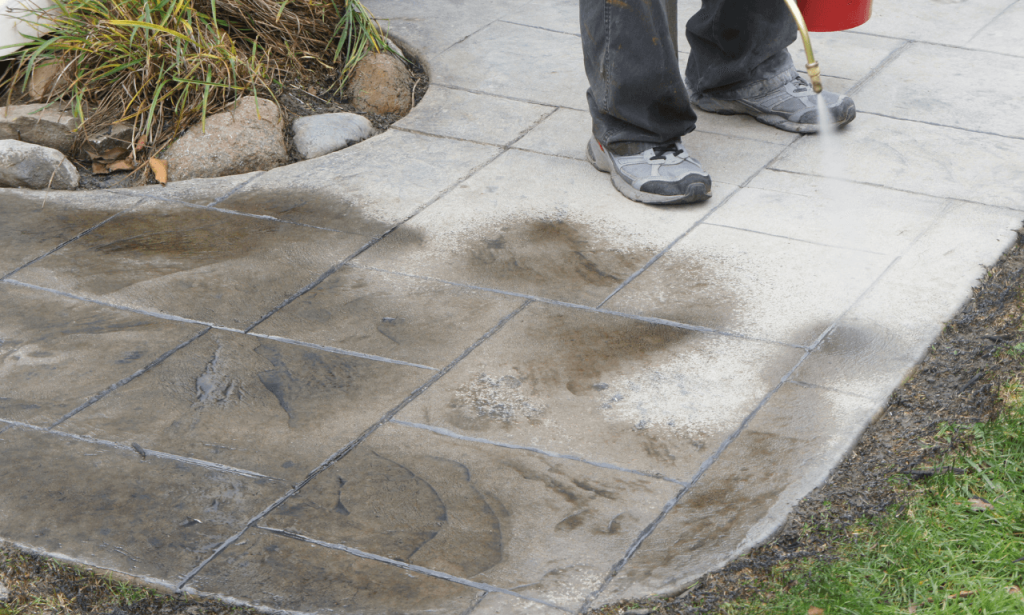
| The honest answer: All concrete cracks. That includes the driveway at the nicest house in your neighborhood. The goal isn’t to prevent every crack. The goal is to control where cracks happen and make sure they don’t affect how your patio works or looks. |
Here’s how we handle it:
- Control joints — We score lines into the slab during the pour. These are planned weak spots. If the concrete wants to crack, it cracks along those lines — where it’s least visible. Think of it like perforations on a paper towel. The tear goes where you planned it.
- Sub-base prep — This is the most important step. We compact a gravel base before every pour. In Austin’s clay soil, this is non-negotiable. Skipping it is why cheap jobs fail.
Two Austin-specific risks to know:
| Risk | What Happens | How We Handle It |
| Clay soil movement | Soil swells/shrinks with rain and drought | Compacted gravel base on every pour |
| Freeze events | Rare but real in Austin — stresses slab edges | Proper pour timing and correct slab thickness |
What we tell homeowners who are nervous:
Most cracks that appear in properly installed stamped concrete are cosmetic. They don’t mean the slab failed. They can be filled and restamped. A repaired crack looks far better than an open one, and it doesn’t affect how the patio performs.
A properly installed slab with a good base lasts 25+ years in Central Texas. We’ve seen jobs from the early 2000s in Austin still looking solid today.
What to Expect During Your Austin Stamped Concrete Patio Installation
Most people booking a patio with us have a date in mind. A graduation party. A July 4th cookout. A home listing going live. Here’s exactly what to expect so you can plan around it.
Day-by-day timeline:
| Day | What Happens |
| Day 1 — Morning | Site prep, form-setting, gravel base compaction |
| Day 1 — Same day | Pour, color hardener broadcast, stamping, initial finish |
| Day 1–2 | Curing compound applied; no foot traffic for 24–48 hours |
| Day 7 | Sealer application; light foot traffic OK after 24 hours |
| Day 7–10 | Full outdoor furniture use — patio is ready |
Best times of year to pour in Austin:
| Season | Months | Why It Works |
| ✅ Spring | March – May | Mild temps, lower humidity, ideal cure times |
| ✅ Fall | September – November | Same as spring — our most booked window |
| ⚠️ Summer | June – August | Workable but requires extra steps |
| ⚠️ Winter | December – February | Rare freeze risk; schedule carefully |
What summer pours actually look like:
Austin summers are genuinely intense — and getting more so.
Austin summers are genuinely intense — and getting more so. Research from Inside Climate News and the Texas Tribune has documented how dangerous outdoor conditions in Texas have become, particularly for anyone working outside during peak hours.
When we pour in summer, our crews start early — before 7am when possible. Concrete sets too fast in afternoon heat. For stamped work specifically, we use retarder additives to slow the set time and shade the slab while we stamp. If we can’t control those conditions on a given day, we’ll reschedule. A rushed stamp on a hot afternoon shows — and we’re not willing to do that to a customer’s patio.
| From our crew: “Summer pours in Austin are doable, but you’ve got maybe a two-hour window to stamp before the surface gets away from you. We don’t rush it and we don’t cut corners on the additives. If the weather’s not cooperating, we call it and come back.” |
Keeping Your Austin Stamped Concrete Patio Safe, Sealed, and Looking New
You’re close to booking. You’ve picked your pattern. Now you’ve got two last questions: is it slippery for my kids, and how much upkeep does this really take?
On slip resistance:
| Important: Stamped concrete can be slippery when wet — especially if it’s been over-sealed. This comes up a lot with pool patios and outdoor kitchens. |
The fix is simple and we do it on every job. We add a non-slip additive directly into the sealer before we apply it. It gives the surface grip without changing the look. If you have kids running in and out of a pool, this step is not optional — it’s standard practice for us.
Sealing schedule for Austin homeowners:
| Timeframe | What To Do |
| Every 2–3 years | Reseal the surface |
| Annually | Visual check — look for color fading |
| As needed | Rinse with garden hose |
| Never | High-PSI pressure washing or deicing chemicals |
Why Austin needs more frequent sealing than most places:
Austin’s UV index is high. We’re not in the Pacific Northwest. Sun exposure here breaks down sealer faster than it would in cooler states. When you see the color starting to look washed out, that’s your sign. Don’t wait until the surface looks chalky.
A specific note for Round Rock homeowners:
If you have large live oaks over your patio — and a lot of Round Rock yards do — tannin drip from the leaves will stain your concrete over time. It’s a dark, rust-colored stain that’s hard to remove once it sets. A penetrating sealer may provide better stain resistance in that situation. We’ll tell you at the estimate if we think it applies to your yard.
| Editorial Note: Penetrating sealer performance claim softened to “may provide”. Recommend client or subject matter expert confirmation before publishing. |
For South Austin families with pools:
We’ve done a lot of pool deck work in South Austin. The combination of wet feet, sun, and a stamped surface gets slippery fast without the right sealer treatment. We always include the non-slip additive on pool surround jobs — no upcharge, just the right way to do it.

Does Stamped Concrete Add Value to an Austin Home?
If you’re planning to sell in the next few years — or you’re an investor getting a property ready in East Austin or Manor — this section is for you.
The short answer: Yes. But not because of some appraisal formula. It’s because of how buyers react when they walk the backyard.
Austin buyers expect outdoor living space. It’s part of the culture here. A worn-out slab — or no patio at all — becomes a negotiation point. Buyers subtract for it. A finished, well-maintained stamped patio tells a different story. It says the home has been cared for. It photographs well. It makes the backyard feel finished.
What we’ve seen in Austin’s market:
| Buyer Type | What They’re Looking For | How Stamped Concrete Helps |
| Growing family | Usable backyard, safe surface for kids | Finished entertaining space, slip-resistant seal |
| Home seller | Strong listing photos, fewer buyer objections | Visual wow factor, signals home maintenance |
| Investor / flipper | Fast turnaround, clean finish | Quick install, low maintenance look |
| East Austin buyer | Distinctive design, neighborhood aesthetic | Custom patterns fit the South Congress / East Austin vibe |
| Our take on East Austin and South Congress specifically: Buyers in those neighborhoods are design-conscious. A basic broom-finish slab won’t move them. A well-chosen stamped pattern — flagstone, wood plank, ashlar slate — fits the aesthetic of those neighborhoods and holds up to the scrutiny of buyers who know what a finished outdoor space looks like. |
We install for personal-use homeowners and investors prepping properties for sale. If you’re working on a flip or rental, we can work around your timeline and provide proper documentation for your records.
Frequently Asked Questions
Accordion Content
Ready to Plan Your Austin Stamped Concrete Patio?
We’ve worked in backyards all over Austin — Cedar Park, Round Rock, Georgetown, Buda, Kyle, Westlake Hills, East Austin, South Austin. We know the soil conditions, the sun exposure, and what Austin homeowners actually want when they picture their finished backyard.
If you’re ready to stop looking at a cracked slab or a bare dirt patch — let’s talk. We’ll come out, look at your space, and give you a straight answer on what it takes and what it costs.
Contact us today to schedule your free on-site estimate. Most Austin-area projects are scheduled within 2–3 weeks.
Do not settle for a plain slab when stamped concrete is within reach. Call (512) 337-4425 today and let’s talk about the right finish for your Austin backyard.